2026年5月份工作及財政簡報

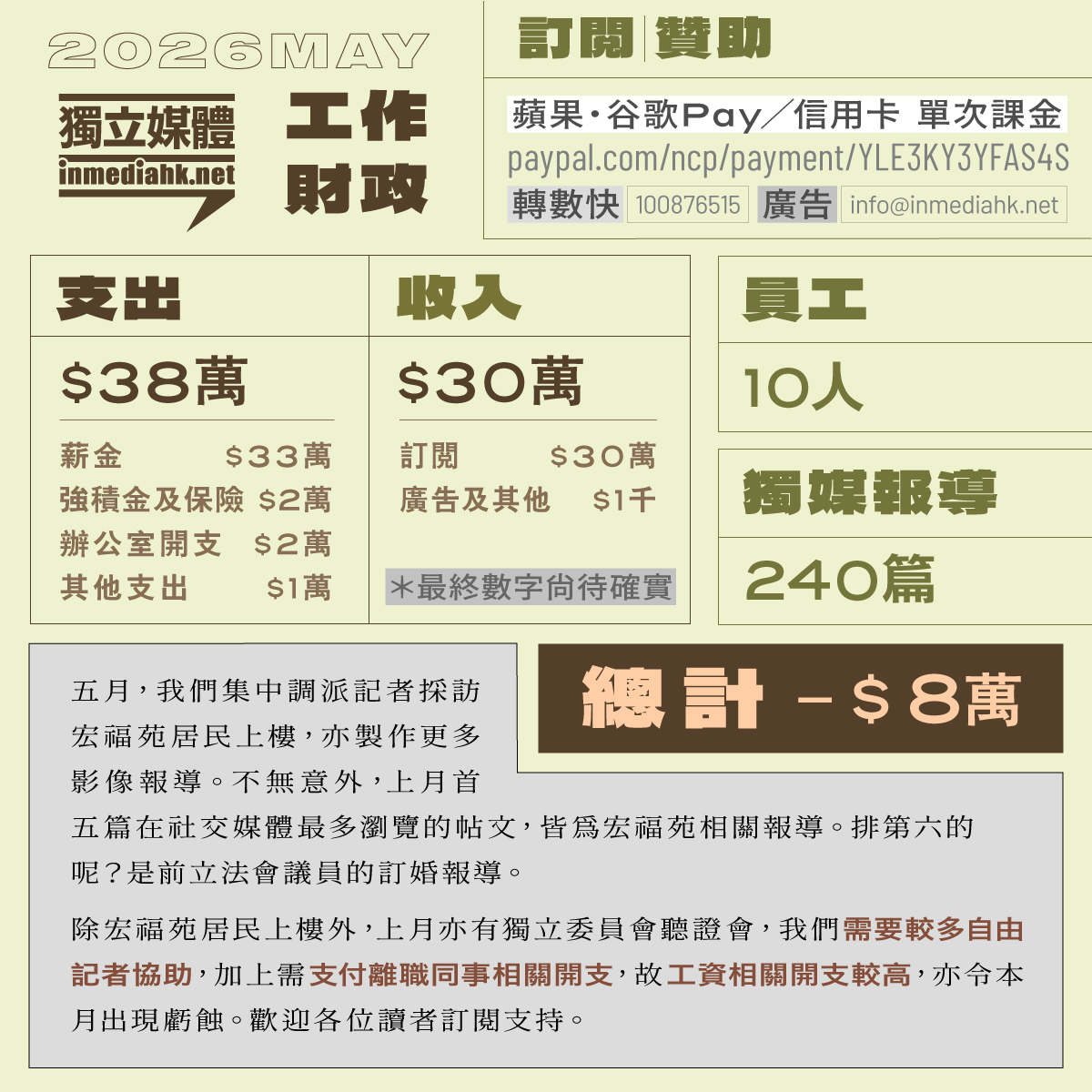
五月,我們集中調派記者採訪宏福苑居民上樓,亦製作更多影像報導。不無意外,上月首五篇在社交媒體最多瀏覽的帖文,皆為宏福苑相關報導。排第六的呢?是前立法會議員的訂婚報導。
除宏福苑居民上樓外,上月亦有獨立委員會聽證會,我們需要較多自由記者協助,加上需支付離職同事相關開支,故工資相關開支較高,亦令本月出現虧蝕。歡迎各位讀者訂閱支持。
單次課金
▌https://www.paypal.com/ncp/payment/YLE3KY3YFAS4S
▌轉數快亦可:100876515
月訂/年訂支持
▌https://inmediahk.net/supportus
獨立媒體
2026年6月
▌員工人數:10人
▌2026年5月份獨媒報導:240篇
薪金:$330,955
強積金及保險:$23,815
辦公室開支:$15,771
其他支出:$13,390
▌合共支出:$383,931
訂閱收入:$303,875
廣告及其他收入:$1,110
▌合共收入:$304,986
▌總計:-$78,945
*最終數字尚待確實
Hi: I need help from people who love science! Can data center cooling loops recycle electricity from condensation as MIT's groundbreaking 2013 experiments suggest?
As data centers face an unprecedented energy and cooling crisis driven by AI infrastructure, billions are being spent on managing thermal phase changes—specifically evaporation and condensation.
In my latest work at Decoding Science, I’ve outlined a simple backyard citizen-scientist experiment that suggests we fundamentally misunderstand electron behavior during these phase changes. Standard solid-state models predict a neutral net current during condensation on these surfaces, but geometric manipulation reveals a measurable electrical anomaly.
If this anomaly scales, it means the massive humidity and condensation loops already running inside data center cooling infrastructure could be harnessed to harvest electricity directly from waste heat. Perhaps equally significant is how understanding evaporation will facilitate the cooling process.
I’ve laid out the simple, reproducible experiment to prove this effect. Would you be interested in a brief look at how rethinking electron kinetics during condensation could impact the future of data center efficiency?
Best regards,
Thomas Alan White